- Polytech
- EMNS
-
Share this page
Cellular Membrane-Targeted Europium(III) Probe for Selective and Time-Resolved Detection of Peroxynitrite
Published on August 12, 2026
– Updated on August 12, 2026
A new paper on the collaborative work with Steve Butler's lab has been published in Chemistry – A European Journal.
by Jamie Webb, Rebecca Tiffany, Karolis Norvaisa, Hennie Valkenier, Lea Miebach, Sander Bekeschus, Stephen J. Butler
First pubished: 30 June 2026
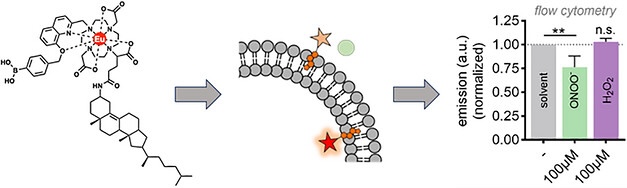
Peroxynitrite (ONOO−) is an extremely short-lived and highly reactive species whose biological effects depend on its local concentration at the site of formation. Consequently, detecting and quantifying ONOO− requires probes that combine high selectivity with well-defined subcellular localization. The cell membrane is a particularly important yet underexplored interface, as it is the first barrier encountered by extracellularly generated ONOO− and determines how much of this species penetrates into the cell. Such membrane-proximal ONOO− formation occurs during inflammatory processes and oxidative stress–based therapies, and is especially relevant in cold atmospheric plasma treatment, where complex RONS mixtures interact with the membrane before intracellular effects arise. Here, we report Eu.Chol, a luminescent europium(III) complex that integrates a phenylboronic acid ONOO− reactive motif with a cholesterol anchor to localize the probe within lipid bilayers. We demonstrate that Eu.Chol incorporates efficiently into liposomes and Jurkat cells, enabling selective, membrane-localized ONOO− detection with minimal response to H2O2. These results establish a modular europium(III)-based scaffold for targeted ONOO− sensing, enabling potential incorporation of organelle-specific targeting groups to probe RONS dynamics at defined sub-cellular sites.
First pubished: 30 June 2026
Peroxynitrite (ONOO−) is an extremely short-lived and highly reactive species whose biological effects depend on its local concentration at the site of formation. Consequently, detecting and quantifying ONOO− requires probes that combine high selectivity with well-defined subcellular localization. The cell membrane is a particularly important yet underexplored interface, as it is the first barrier encountered by extracellularly generated ONOO− and determines how much of this species penetrates into the cell. Such membrane-proximal ONOO− formation occurs during inflammatory processes and oxidative stress–based therapies, and is especially relevant in cold atmospheric plasma treatment, where complex RONS mixtures interact with the membrane before intracellular effects arise. Here, we report Eu.Chol, a luminescent europium(III) complex that integrates a phenylboronic acid ONOO− reactive motif with a cholesterol anchor to localize the probe within lipid bilayers. We demonstrate that Eu.Chol incorporates efficiently into liposomes and Jurkat cells, enabling selective, membrane-localized ONOO− detection with minimal response to H2O2. These results establish a modular europium(III)-based scaffold for targeted ONOO− sensing, enabling potential incorporation of organelle-specific targeting groups to probe RONS dynamics at defined sub-cellular sites.
Graphical Abstract
We report a cellular membrane-targeted europium(III) probe, Eu.Chol, that enables selective, time-resolved detection of peroxynitrite (ONOO−) at the cell membrane interface. Eu.Chol demonstrates efficient incorporation into liposomes and Jurkat cells, with minimal response to H2O2, establishing a modular platform for subcellular ONOO− sensing.