
- Polytech
- EMNS
-
Share this page
Color-tunable luminescent TbxEuy(BDC) complexes assembled within liposome-based nanoreactors
Published on June 12, 2026
– Updated on June 12, 2026
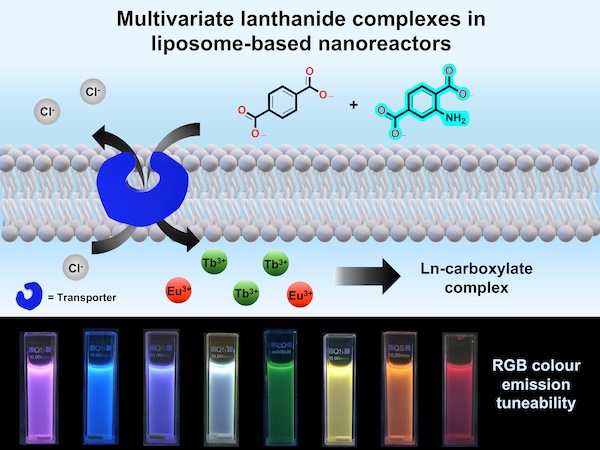
This new publication highlight the development of liposome nanoreactors that assemble multimetallic lanthanide complexes inside attoliter compartments. Real-time photoluminescence monitoring reveals distinct Tb3+ and Eu3+ emission behavior, while ligand engineering enables RGB color tuning, providing a platform for studying coordination chemistry and designing luminescent nanomaterials in aqueous environments.
by Aaron Torres-Huerta, Miriam de J. Velásquez-Hernández, Sven Lempereur, Ludovic Troian-Gautier, Giulia Veronesi, Hennie Valkenier
in Cell Reports Physical Science
First published: 8 May 2026 Precise stoichiometric control in multimetallic lanthanide nanosystems is essential for optical devices, sensing, and bioimaging applications owing to their composition-dependent emission properties. However, controlling metal composition, spatial distribution, intermetallic energy transfer, and colloidal stability remains challenging. Here, we report a liposome-based nanoreactor platform that enables the in situ formation of multivariate TbxEuy-dicarboxylate complexes, enabling finely tuned lanthanide stoichiometry within attoliter-scale confined volumes. Liposomes pre-loaded with specific Tb3+:Eu3+ ratios are combined with a synthetic anion transporter that mediates dicarboxylate transport through lipid membranes, enabling controlled coordination reactions in aqueous solution. This method, coupled with the use of a blue-emissive ligand, supports continuous color tuning across the entire RGB spectrum. Real-time emission spectroscopy reveals faster photoluminescence appearance for Eu3+ than Tb3+, providing experimental insight into lanthanide reactivity under nanoscale confinement. These findings position liposome-based nanoreactors as a versatile platform for investigating coordination reactions and engineering multimetallic luminescent colloidal materials in aqueous media.
in Cell Reports Physical Science
First published: 8 May 2026 Precise stoichiometric control in multimetallic lanthanide nanosystems is essential for optical devices, sensing, and bioimaging applications owing to their composition-dependent emission properties. However, controlling metal composition, spatial distribution, intermetallic energy transfer, and colloidal stability remains challenging. Here, we report a liposome-based nanoreactor platform that enables the in situ formation of multivariate TbxEuy-dicarboxylate complexes, enabling finely tuned lanthanide stoichiometry within attoliter-scale confined volumes. Liposomes pre-loaded with specific Tb3+:Eu3+ ratios are combined with a synthetic anion transporter that mediates dicarboxylate transport through lipid membranes, enabling controlled coordination reactions in aqueous solution. This method, coupled with the use of a blue-emissive ligand, supports continuous color tuning across the entire RGB spectrum. Real-time emission spectroscopy reveals faster photoluminescence appearance for Eu3+ than Tb3+, providing experimental insight into lanthanide reactivity under nanoscale confinement. These findings position liposome-based nanoreactors as a versatile platform for investigating coordination reactions and engineering multimetallic luminescent colloidal materials in aqueous media.