
Published on October 14, 2026
– Updated on October 14, 2026
We were pleased to host Amina from the Ruđer Bošković Institute of Zagreb in our laboratory last summer. The research work on micelles carried out during her stay has just been published.
Nonionic Pyrene-Based Amphiphiles Forming Wormlike Micelles: Synthesis and Characterization
First pubished: 8 Ocyober 2026Abstract
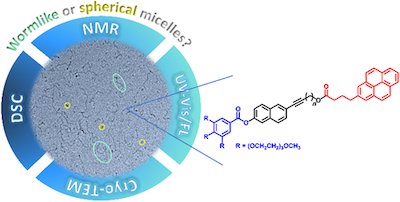 Wormlike micelles are elongated, flexible supramolecular assemblies whose dynamic structure and anisotropic morphology have attracted considerable interest as functional soft materials. The self-assembly of amphiphilic molecules into anisotropic supramolecular nanostructures is governed by a delicate balance between hydrophobic, hydrophilic, and directional noncovalent interactions. Here, we report the synthesis and selfassembly behavior of a series of nonionic pyrene-based amphiphiles bearing oligo(ethylene glycol) headgroups. The aromatic cores promote directional self-assembly through π−π interactions, while systematic variation of the linker length was employed to elucidate its influence on aggregate morphology in aqueous media.
Fluorescence spectroscopy demonstrated that these amphiphiles exhibit a strong tendency to aggregate in water, while NMR spectroscopy confirmed their highly aggregated state. Rather than exhibiting a well-defined critical micelle concentration, the compounds revealed a multistep aggregation process. Cryogenic transmission electron microscopy (cryo-TEM) showed that structural modifications direct the formation of either spherical or wormlike micelles, highlighting the role of the linker length and hydrophilic content in governing aggregate morphology. Differential scanning calorimetry and temperature-dependent cryo-TEM analysis revealed thermally induced reorganization of the assemblies, with wormlike micelles evolving into larger aggregates prior to macroscopic phase separation. These results establish structure−property relationships for a new class of pyrene-based nonionic amphiphiles and demonstrate that subtle molecular modifications provide an effective strategy for controlling wormlike micelle formation and thermally induced structural reorganization in water.