
We are pleased to highlight the recent publication of Alessia Fantoni’s PhD research in Chemistry – A European Journal. Her work presents a gold-nanoparticle-based colorimetric nanosensor capable of rapidly and selectively detecting biologically relevant polyamines in water, offering a simple and promising approach for future non-invasive disease diagnostics.
Calix[5]arene Functionalized Gold Nanoparticles for the Selective Detection of Polyammonium Species in Water
by Alessia Fantoni, Romain Carpentier, Nemo Raffoul, Andrea Pappalardo, Antonella Dalla Cort, Kristin Bartik, Gilles Bruylants
in Chemistry - A European Journal
First published: 18 February 2026
https://doi.org/10.1002/chem.202503596
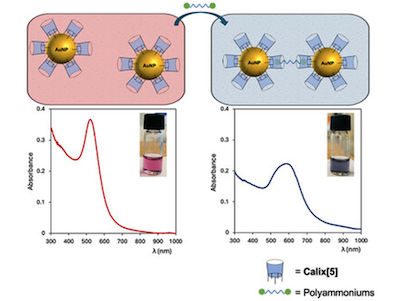
The development of sensors capable of selectively detecting polyamines in aqueous environments is crucial for early and noninvasive disease diagnostics. These aliphatic cations participate in fundamental cellular processes, and their dysregulation has been linked to several cancers and neurodegenerative disorders. Although conventional detection methods, such as chromatography and mass spectrometry, offer excellent sensitivity, their complexity, cost, and limited portability restrict their use in rapid or point-of-care testing. This work presents a colorimetric nanosensor based on gold nanoparticles (AuNPs) functionalized with a p -tert-butyl-calix[5]arene derivative ( Calix[5] ), a supramolecular receptor with selectivity for primary alkylammonium ions imparted by intracavity host–guest complexation. The molecular recognition event induces interparticle bridging, triggering nanoparticle aggregation that manifests as a visible color change of the suspension. The system exhibits remarkable chain-length- dependent selectivity: long polyammonium chains, such as 1,12-dodecanediammonium and the biogenic polyamine spermine, induce rapid ( < 5 min) nanoparticle aggregation, resulting in a distinct plasmonic shift. In contrast, shorter analogues (spermidine, 1,6-hexadiammonium) show negligible responses. These findings demonstrate a simple, rapid, and cost-effective approach for the selective sensing of structurally defined polyamines, with potential applications in noninvasive biomarker monitoring.